Showing posts with label Slight Whinge. Show all posts

Monday, 14 March 2022

River Graveney Walk (part 2)

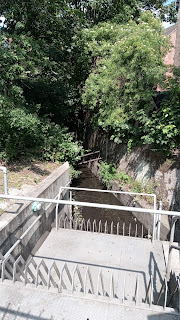
Somewhere under London Rd/Streatham High Rd (Google and the actual road sign are in dispute which it is at this point) the Norbury Brook becomes the River Graveney. It's a relatively easy thing to find, either coming straight from my last post, in which case it's dead ahead over the road, or from Norbury Station, in which case cross the road and walk up the left hand pavement until you come to it. The river emerges under a slightly arched bridge with two tunnels (despite disappearing under a flat bridge with one) and can be walked for a short stretch along Hermitage Path. 


Looking back towards Streatham High Rd


Hermitage path leads through a small housing estate and if you keep straight ahead and under the railway bridge it will take you to Woodmansterne Rd. Turn right into Sherwood Avenue, which first crosses (invisibly as far as I can see) and then runs parallel to the river. On your left a short way up will be an alley you want to turn down. It leads over the river to Runnymede Crescent. 


Turn right into Runnymede Crescent and continue down the right hand pavement. At the end turn right back into Woodmansterne, then next right into Hawkhurst. What you're essentially doing in this bit is zigzagging: left into Sherwood, walk on for a bit, then left into Helmsdale, right into Woodmansterne, right into Streatham Vale, left into Braeside Rd. The river is fenced off - mostly with gates at all the points you're crossing it, but it can be seen. 

If you look to your left at the end of Braeside Rd as you cross Abercairn Rd, you'll see a yellow barrier more or less where the Graveney is too. It's about to dive underground again though. Or rather, the ground is about to rise.  

Cross Abercairn and walk up Bates Crescent and into Eardley Road Sidings Nature Reserve and take a right along the path (or if you prefer you can turn left and circuit the whole thing). Ahead of you will be the railway these sidings were reclaimed from. The Graveney runs straight under the embankment, but as three distinct railway lines meet in this area the pedestrian has to take a long detour. 

Go back to Abercairn Rd and turn left into it. Turn right at the end into Aberforth Rd, and then left into Carnforth Rd (where the cars can't go anymore, but you can). At the end of  Carnforth Rd turn left into Eardley Rd and under the double railway bridge. 

Turn left into Besley Street, and at the end turn right into Eastwood Street and left into Fallsbrook St. Fallsbrook Street runs straight ahead for a bit and then turns sharp right to follow the Graveney, which is hidden behind the houses. I've explored and there's no way to actually see it along this or the corresponding road on the other side of the river (Rural Way), until you reach the end of the road where it flows under Mitcham Lane.


A plaque on the bridge appears to be a boundary marker - one side LCC (presumably for London County Council) one side SCC, for Surrey County Council, whose headquarters were in Kingston and who were clearly very worried about what might happen to the bridge up on the northern wilds of their domain:


Cross Mitcham Lane - probably best to use the crossing - and turn up Southcroft Rd, which you'll notice slopes steeply down on the left hand side, although you can't see anything behind the large buildings with their concrete front gardens. 

In Swain Close, on the left, there is one corner you can get a glimpse of the river if you're tall, or raise your phone up like I did. Frankly its a sliver, but it's reassurance that it's there. 

Walk along and turn left up Eastbourne Rd. 


And right into Seely Rd. Again you're parallel but cannot see the river. I even wandered into a mews of new builds just before Amen Corner, but the river must be underground at that point as there was nothing. 

At the end of Seely Rd turn left into Mitcham Rd. Just before the railway line turn right into Longley Rd (note the slope down again) and then left just before the church down a footpath to the bridge over the railway line. According to the map the Graveney resurfaces a little further along the railway line - but I suspect it's only visible when it floods. If you look right while crossing the bridge there's quite a lot of undergrowth which may indicate water, but nothing definite. 

Cross the bridge and turn right into Robinson Road. You will pass a few closes on your right, but as with Longley Rd there is no evidence of water until the very last - and then you can only get to it if the carpark gate is open. Again it's a sliver. 

At the end of Robinson Rd there is a kind of weir I've photographed before. 


At this point the Graveney appears to run underground until it emerges alongside the railway line off Wandle Meadow Nature Park. I've tried the roads on the right where it appears to be heading, and mostly hit dead ends of railway line and there is no sign of water. 

The easiest and pleasantest way to continue the walk is to turn left out of Robinson Road and walk straight ahead to Colliers Wood, crossing the road at the Charles Holden Pub and walking straight ahead into the park (pub now on your left, flats on the right). Aim for the top right corner entrance (past the children's playground) into Byegrove Road (running along the left boundary of this park by the way is the Wandle, which the Graveney is about to join. You're currently on what is known as the Wandle Path, a popular route for cyclists, dog walkers and those heading to Plough Lane on match day.) 

Cross Byegrove Road and go down the footpath on the left just as Byegrove turns into Denison Rd. The path will become a road alongside a railway line, then a path again under a railway bridge. Just keep walking. Shortly after the railway bridge a concrete wall on your left indicates the river has re-surfaced. 


If you keep walking you will come to a metal walkway over the river, from which you can see where the Graveney becomes part of the River Wandle. 


(Incidentally after this I went round to Lambeth Cemetery, which is on the other side of the railway line to all those dead ends I mentioned earlier. It's sloped and very damp in the spot nearest the railway track, and there's an absence of graves in the damp spot, so if I had to guess I'd say the river is culverted to cut straight back to the railway from Robinson Rd, and then runs underground alongside it).  

Tuesday, 8 March 2022

River Graveney Walk (Part 1: Norbury Brook)

The Norbury Brook - which becomes the River Graveney downstream, and eventually flows into the Wandle just beyond Colliers Wood - is, as I've said before, an elusive beast. It rises, according to Wikipedia, 'somewhere near Lower Addiscombe Road' but becomes visible from Heaver's Meadow. Anyway, in the absence of any clear idea where it actually runs between those two points, and on the basis that green spaces are a) more pleasant to walk through and b) possibly there because of unstable ground due to a buried waterway, I've designed my own meandering route for the first part.

Unusually for me, I'm also going to make these instructions as clear as possible as I can't see that anyone else has posted a guide to walking this brook, so this is a warning in advance that this will probably be a long, picture-heavy, not especially chatty, post. 

From Addiscombe Tram Stop:

Turn right and walk along the right hand pavement until you reach East India Way. There will be a number of other roads leading off to the right before that, and the park you're heading for runs along the back of these, but those roads end in spiky metal fences rather than gates.

Anyway to walk the length of the park East India Way is best. Pass under the arch and walk straight ahead.

According to Croydon Council website East India Estate (a conservation area over the other side of Lower Addiscombe Road from where you are) is on the site of the former East India Trading Company Military Academy. I'm not sure if this road was also a part of that academy, but it seems likely. Boggle, if you like, at the concept of a private company being allowed to train an army to protect its interests abroad. Friends and shareholders in high places? Or pure Imperialism?  

At the end of East India Way there is a footpath and gate into Addiscombe Railway Park. On the left is the community garden, and if you look back you can see central Croydon, which is casting multiple buildings up to the sky at present. Croydon was heavily bombed during the Second World War (presumably because of the airport and the good train links to London and the Coast) and came back with a lot of concrete 'space age' type buildings that look dated now but must have seemed like the clean, uncluttered future sixty years ago. I think it's trying to pull the same trick again, but although I wish it luck, I'm not sure it's going to work a second time.

Is it just me or does this look unnervingly like a grave? Here lieth the body of Addiscombe Railway. 

You want to walk the full length of the park and come out at Blackhorse Lane tram stop. Climb the steps or ramp up to the bridge over the tram line and turn right. Bear right onto Woodside Green, ignoring Elmers Rd, which is before it. 

At the green itself, with it's war memorial, bear left and then turn left down Dickenson's Lane. There is a path straight ahead at the end which takes you to Brickfield's Meadow. A noticeboard on the right will tell you all about the brick factory which used to be here, which is just as well because I can't remember a word of it beyond those bare facts. 

This is actually a lovely spot, even in the drizzle. Keep walking forwards - a pond should appear on your left. You can go round the pond at the top or down to cross the small and muddy bridge. 


Brickfield's Meadow 

At the top right of the pond (from the end you originally approached it from) and with the pond to your back head through the car parks or stick to Christie Drive to get to Davidson Road. 

Davidson Road runs parallel to roads called Canal Walk and Towpath Way, which sound promising, but if the brook is here it's firmly underground, so you may as well turn right into Davidson Road at the end of Christie Drive, and once at the end of Davidson Road left into Tennison Rd, which will take you over the railway line. On your right is South Norwood Rec, and on your left just a bit further down is Heavers Meadow (it's signposted and just before the Zebra crossing). 

Down this same dead end is also Heavers Farm primary school (I keep wanting to put an apostrophe in both of those, on the basis that surely Heaver must have been a person or people, but history, or at least google, if not forthcoming about who or what Heaver was). 

Internet sources are forthcoming about the fact that Heavers Meadow is a water meadow, which I can confirm from direct observation.


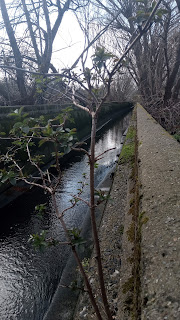
A tarmacked path runs up the left hand side to keep you dry, alongside a metal fence the other side of which the brook will eventually appear, fenced off. 

The reasoning behind culverting these natural streams in London, which has been going on for a good hundred years or more, was to speed water out of an area as fast as possible and prevent flooding - but doesn't always work, can cause problems downstream and often involves deep concrete channels in which water rises very quickly (hence the fence). Some areas are now trying planting and encouraging their local brooks to take a more meandering course to slow them down and create green corridors. If anyone were to try that with this brook a water meadow would seem the place to start it. 


Taken through the fence. Most of the pictures on this section are taken through fences or over walls meant to deter people getting in the river. 

As with the Railway Park, you simply walk to the end of Heavers Meadow until you get to Selhurst Road, where the brook goes underground again. Over the road to your left is Selhurst station.  


This very attractive rondel is outside the station, and made by artyface.

For the next stretch you need to be the other side of the railway line. The easiest way to do that is to go under the railway bridge by Selhurst station and directly right up Edith Rd. You can then turn right into Dagnell Park or walk up a bit further and wait until Eileen Rd (what is the story behind these roads being named Edith and Eileen I wonder? Sisters? Daughters? Or just 'we had to name them something'?) either way you will get to Saxon Rd, where you turn left and then right into Whitehorse Rd. You should be diagonally opposite a small church/chapel. 

Cross Whitehorse Rd but continue along it to Bensham Manor Rd (I've explored the road with the chapel in it and the housing estate and found no sign of the brook at all). 

Turn down the second road on your left, Swain Rd, and walk along the left hand pavement. About halfway down is Treetops Court, and if you turn in there you will find the brook has resurfaced, running between the car park and a row of properties each with it's own small bridge. Here the pedestrian is only protected from it by a wire fence, and a low one of just four wires at that, which seems at odds with how it's fenced off elsewhere, but may be because these are newer builds and as I said, attitudes have changed. Go back to Swain Lane and continue walking down the left hand pavement, and then turn right, and next right again into Ecclesbourne Rd. 


If you're taller than me (and most people are) you may be able to see over the wall halfway down Ecclesbourne behind which the brook is. If not you can do what I did for many of the pictures I took on this walk, which was hold my camera up above my head and tilt it down to snap a picture to look at later. Thus:


I won't post all these. They're all quite similar, although some have a much better feel for how deep that culvert runs (you can see how it would be treacherous) and in others you can see how surprisingly fast the water flows. 

At the end of Ecclesbourne turn left back into Bensham Manor Rd again. A little way down is Bensham Close. If you turn in here and walk to the end (it's not very long) you will come to the brook without any fencing at all. Again, this seems to be because it is a newish development. 


The banks are also thickly planted with some kind of bulb. This will probably be a very nice spot in full spring. 

Retrace your steps to Bensham Manor Rd and turn left at Seneca Rd. If you're a completist, turn left again up Boswell Rd to find another wall hiding the brook, and then retrace your steps to Seneca, walk along Seneca Rd until it becomes Lucerne Rd and you will find another wall almost immediately doing the same thing, again retrace your steps to the corner of Lucerne and Boswell Rd and turn left up Boswell Rd to the Brigstock Rd (I promise these instructions make more sense in situ!). 

This is the main road through Thornton Heath and unmistakable as an outer London high street. If you cross Brigstock Rd (carefully! This is the road where someone beeped his car horn at me because he wanted to park on the bit of pavement where I was standing. He wasn't particularly antagonistic, mind you, he just thought pavements were for parking on and to be fair to him when I looked around it was clear he wasn't the only one.) you'll find Brook Rd straight ahead, but first turn left to walk a little way down Brigstock Rd to find a low wall over the brook. 


Now go back to Brook Rd. The brook itself runs round the back of the houses. You can turn left up Quadrant Rd to get another pic very similar to the one(s) you have and then retrace your steps, or just keep straight ahead as Brook Rd turns into Carew Rd and arrives at Thornton Heath recreation ground. 

There is a community garden on your right just inside the gate, with a fine showing of daffodils right now, but you want to keep left along the path until it meets the brook (again behind a fence) on your left hand side. It you keep walking you will pass the other park entrance with it's bridges over the brook and eventually hit the fences of people's back gardens at the far end. Turn round and go back to the entrance with the bridges and cross the brook. 

Turn right along Bridport Rd and right again into Braemar Avenue. Again there is a barrier, this time about a third of the way down the road, but you can see the brook (or at least the channel and lush growth) around it. 


Incidentally if you've done all this, I estimate you've done at least six miles walking (I'd done more than eight, what with the diversions). We'll go just a little further to Norbury, and you can get a coffee or bail out until next time.

Continue down Braemar and turn left, then left again into Strathayre Avenue. Just before the road on the right (Dalmeny Rd) the brook runs diagonally under Strathayre, but it appears to be behind people's gardens or front hedges and there's only so nosy I'm prepared to be. 

Anyway you want to go down Dalmeny. Walk along until you get to Ederline Avenue on the right. Along Ederline is a metal fence, and on the other side of the road a metal fence and gate. Brook still there, running along behind the terraces. Sadly despite a strongly worded notice from Croydon council basically saying 'this is not a dumping ground and we will fine you' one side has been turned into a dumping ground at this present time. Continue along Ederline and turn left into Norbury Crescent. 

Turn right at Manor Farm Rd and under the railway line. You can read about the Manor (and later the farm) on Hidden London here. There is also an antique postcard of the farm for sale online, but from the picture it just looks like a farm. Big house, field, pond. 

There is a short curved stretch of the brook on your left as you come out from under the bridge (picture again taken through the fence). 


Turn left out of Manor Farm Road into Norbury Avenue. Continue along the right hand pavement until you come to a footpath and allotments, Turn down the footpath, which runs over the brook and at the end of the path turn left through Norbury Park.  

According to the map there's water diagonally across Norbury Park to the row of yellowish brick buildings opposite - actually there's no water but just a lot of quagginess underfoot (maybe it floods sometimes?) anyway aim for those yellow buildings and you'll find the brook surfaces again in the usual concrete channel. Walk along with the brook on your right, and continue straight ahead through the car park when it ends. 


I want to say you're now on Norbury High Street, but apparently it's not called that. Left for the train station, either direction for pubs, cafes, restaurants, buses. Straight ahead on the other side of the road the brook becomes the River Graveney, which I'll come back to in part 2. 

Thursday, 10 September 2020

Ngaio Marsh: Clutch of Constables

One of the interesting things about reading a series in order for the first time is seeing groups of books together in ways you might not have previously noticed. I had never noticed, for example, that first Troy and then Alleyn are on holiday alone in a small group of strangers in two consecutive books - although the other spouse is always in the wings somewhere, being written to, and an explanation given for why their son Ricky is not with Troy in the first one when she decides to take an impromptu canal tour of the waterways. 

And promptly falls down a kind of rabbit-hole into the middle of something strange and unpleasant which she gets flashes of but doesn't really understand. Something that could be easily dismissed as fancy if it weren't interleaved with a lecture Alleyn is giving to students at a much later date, describing the case in hindsight. 

And yet.. I didn't find it gelled. That lecture only interrupts the flow, and I was deeply disbelieving of so many people's actions and motivations. My first issue is that the Troy of the earlier books is not a person of great instinct. She is a great observer of detail - in previous books she has noticed how full a handbag is at different stages of the evening, or how a young child spells grandfather, even before she had any reason to think it mattered - but that is not the same thing. Here we have something more like intuition, which I feel she has always distrusted before. 

Then there are the police stations she's calling into, whose officers essentially patronise her and yet tell her to go to the next police station when the boat arrives there, which is just plain inconsistent - if they're politely trying to put her off why do they keep asking her to drop in? Then make it sound as if she's the one insisting on seeing them? 

The actions of the murdered woman and the criminals though, are even more particularly ludicrous. 

Gap because there will be spoilers..........


Particularly bewildering things about the victim include: 

Why someone who thought they'd stumbled onto a crime would write it down, even if she was in the habit of writing things down, and then having done so and dropped her journal in the canal by accident, would attract attention to it and thus give someone a chance to look at it. 

Why she would sleep up on deck alone if she was worried.

Why she's been going round telling people she has a Fabergé necklace she always wears. 

Obvious answer to all the above is she's not very bright, which I can accept, although Marsh's portrayals of undersexed middle aged women being unattractive idiots are a tad too frequent for my liking, and sit somewhat strangely with the fact that two of the male occupants of the boat make a dead set for Troy despite the fact she must surely be 50 if not 60 by now. (I can sort of swallow her stepping into the same fountain of youth as her husband, but to have suddenly developed the same fatal attraction as him was a leap too far.) 

As for the crooks:

Why did they move the body the way they did and to where they did? i.e. somewhere on the boat's route back where she would be recognised if found? 

Why did they go ahead with the plan to plant their fake painting locally and use Troy as a witness, given they must have known by then who she was and that she was already suspicious? 

But most of all why are so many of them there - almost everyone on the boat - when that's not at all necessary for the job. Is it the annual works do? Can they claim it back on expenses? So many questions. 

Lastly, how much preparation did they actually do for this major piece of fraud? They didn't even know that the boat went back through the town after closing time and they'd have to take a bus back to plant their cache. 

And all this is meant to be orchestrated by (wait for it) the Jampot, a criminal mastermind who Alleyn is telling his students about however many years later but who should really be textbook example one of  'crooks who are not as clever as they think they are'.

Next time: When in Rome. 

Thursday, 31 May 2018

Sketches..


This is the best sketch of the Alhambra I did in the end and I'm reasonably but not completely happy with it. Reasonably happy because I'd got out of the habit of drawing and painting real things and took an art course in January to get my eye back in, which has clearly worked; but not completely happy because there is absolutely no sense of the scale and monumentality of the buildings in this picture. 

And this is an ongoing theme: as you can see here in my sketch of the torso of Michelangelo's David (done in the V&A as part of that drawing class with the Art Academy):


I am roughly the height of the plinth that David stands on, and the statue is of course enormous. But I seem to have drawn it as though I were looking at it straight on, rather than up at an angle.  Which would be a neat trick if it was on purpose, I suppose, but it isn't, and it throws the perspective off. 

So at least I know what I need to work on. 

Tuesday, 23 May 2017

Croydon


I don't often go into Croydon, despite the ease of access on the tram. I find its street layout confusing and (lets be honest) it's architecture pretty hideous. From the top of the shopping centre car park you can see how the taller buildings seem to have just been plonked down or built up, without any consideration given to how they fit the landscape or the roads around them, and at ground level the older buildings - many of which were clearly attractive once - have been chopped about mercilessly. 

Then both, of course, have been left to get tired and grubby. 

That said, there are some interesting murals and stained glass windows if you look for them, and the museum (which is free) is well worth a visit if you're in the area. I had it to myself on Friday, although the library and cafe in the same building are very well used (and it's an attractive well-lit space that doubles as a gallery too). It's also one of the few places which still has some independent shops hidden away - clothes stores, electricians, drapers. Although that does mean there are sometimes rather odd things for sale. 


 Like this coffee table, for example. 

But that too is at least interesting. 

So fingers crossed the regeneration being planned now is done with a bit more care than some of the previous attempts.  


Sunday, 22 January 2017

Culling Again


Almost invisible on the far left between the field microscope I have no real reason for owning except I like the box it comes in, and the big fat Martin Amis book, is The Case of the Caretaker's Cat by Erle Stanley Gardner, which I'm pretty sure I would have loved in my teens when I was reading Saint novels and Christie's 'Bright Young Things' spy books. It's all a bit too sassy and dramatic for me now. 

Next to that Martin Amis' The War Against Cliche, a collection of essays and reviews. Some of it's great - such as his comments on what used to be called Lit and Soc, and it's demise (or at least, it's painful earnestness and eventual becoming very poorly indeed), his review of Philip Roth, sympathy for Lydia Bennet, and dry appreciation of Martin Seymour-Smith. 
It feels like he's just skimming over the books he's writing about though, a stone across the surface of a pond. Fine for a magazine review intended to give the reader a flavour of such and such a thing to decide if they want it, but not a book I need to hang on to.

Jean Rhys Letters. I gave up on this half way through. She is so thin skinned and I felt like I was nosing into something absolutely none of my business, a fellow human being like a wasp trying to get out of a window and only crashing into it again and again.

Willam Golding The Hot Gates - much of what I wrote about Martin Amis above probably applies here. Individually entertaining essays, but I don't need to read them again.

David Mitchell - Thinking About it Only Makes it Worse - ditto the above.

Matt Haig Reasons to Stay Alive - I'm pretty sure I was given this by an aunt, along with a book by Danny Baker I haven't read yet and Swallow This by Joanna Blythman, with the idea I would read them if I wanted and take them to the bookswap. Blythman was excellent and I'm hanging onto that, and the Danny Baker is on my bathroom bookshelves.
Reasons I took against on the very first page. I'm sure there are people out there this book will help, and I'm glad if it helped Mr Haig to write it, but I don't want to read it. Sorry.

Nicholas Bentley How Can You Bear to be Human - I simply don't find him funny, and since there isn't much to this book except humour and draftmanship there doesn't seem any point in keeping it.

James Thurber Alarms and Diversions - slightly more amusing but not really. I think part of the problem is that the odd cartoon makes me smile, but pages of them make me shrug.

Colin Watson's Coffin, Scarcely Used is a perfectly workmanlike murder mystery that I know the solution to now.

The Various Haunts of Men by Susan Hill is not perfectly workmanlike, it's too long, There are three perfectly good first chapters from different points of view, and for some reason she's included them all. I bailed out at 150 pages. Odd because I've read short stories by Susan Hill and she's good at building tension so surely realised she was letting it deflate over and over here?

The Memorial, Christopher Isherwood. I wrote a review of this here. I won't reread it.

And those last three books on the right are actually library books waiting to be returned. Ways of Seeing by John Berger followed as a logical step on from Breakfast at Sothebys by Philip Hook. Seeing was written in 1971 but is still relevant today. In fact the essay on publicity images is more relevant than ever, and the one on nudes highlights an attitude to women and which women had towards themselves that it's in no-ones interest we slip back into.

Speaking of which Gladys Mitchell's The Devil's Elbow is a nice little murder story badly spoilt by the constant negative 'she asked for it' refrain around the woman who has been killed. She appears to have been a nymphomaniac, or a good time girl. I'm not sure why that's a murdering offence.

On the far right is Heads and Straights by Lucy Wadham, which is one of the best of the 'tube line' books I've read so far. It's the Circle Line, but not really about the Circle Line. I won't say what it is about, because these books are so slim that they're easily spoilt.

Incidentally my least favourite was Waterloo-City, City-Waterloo by Leanne Shapton, which is basically the thoughts of people going to work, and then coming back again, and which was an insult to the human imagination. I don't believe the human being has been born that is as dull as this book makes us all out to be.

Incidentally - or not - one of the characters is reading Mrs Dalloway, in which Virginia Woolf does a much better and richer job of getting inside people’s heads and memories and internal dialogue. Maybe that’s meant to be the point, that people on the Drain going back and forth are duller, or that work anaesthetises us into dullness. I dunno. 

Don't care much. It's that sort of book. 

No idea what this is about but leaving it here.

Tuesday, 29 November 2016

Tooting Market

At the weekend I went, amongst other places, to Tooting Market, which is currently under threat – possibly – by HS2.

I know Tooting Market of old, but it’s at a transition point at the moment. There are the old veg and fruit and fabric stalls and the egg and chip places, and there are the organic beers and sit down restaurant and micro distillery for gin (Graveney Gin).

The gin was what we were there for, because I had been talking about it over a year and hadn’t tried it, and my brother decided a year was long enough.

Very nice it is too. Lovely and refreshing, with pink grapefruit and the unobtrusive sweetness of a Mediterranean tonic. A completely new drink to me. Normally I drink gin which is bitter, and slimline tonic, which is also bitter, because I like bitter things. So it’s very much not gin as I drink it.

I would like a little bottle to experiment with though, and will try to get one. Micro distillery means micro amounts, of course, so they were out of everything but the gift packs. I may have to pre-order online.

Still it’s a civilised spot, and I’ve a vague natal interest in the area. I tend to think of and describe myself as being from Tooting because although I was in fact born in Balham, and although we moved right out when I was 3, we started drifting back in over half my life ago. My Dad is still just down the road and, only slightly across the boundary of the Wandle river, so am I.

The river Graveney, after which the gin may or may not be named (There is also a Tooting Graveney on completely the other side of Tooting from the river, and both are likely named for the Gravenel family who held the land in the 12th and 13th centuries) is the most circumspect of London rivers until it floods – hidden and channelled but rising and falling by metres in heavy rainfall and fenced off for safety’s sake where it does come up for air. In fact it’s only a tiny stretch that qualifies as the Graveney at all. Before that point it’s the Norbury Brook and almost immediately after Tooting it flows into the Wandle and joins the meander through Wandsworth to the Thames. Should it ever become a character in the Rivers of London canon it will be the smaller, shyer twin, co-dependent, suffering a severe identity crisis, and occasionally bursting out in furious temper when pushed too far.

Back in the real world the market, as I say, seems to be at a transition point. If they don’t knock it down I suspect the rents will go up and in ten years it will be where Merton Abbey Mills and Borough market went, almost all artisan, and shortly after that the kitsch shops and chains will move in, the oddities will be priced out, and that will be the end. 

I don’t know if that’s a complaint on my part or not. I don’t particularly avoid chains, especially those that are good at what they do and provide me with free wifi, and I do feel that there is an organic quality to what happens to property of this kind in London. An ebb and a flow. And while there’s also the occasional destructive flood which leaves nothing of interest behind, something new and interesting always pops up somewhere else, like flotsam, and.. and I’m not going to hammer that metaphor any harder home. 

What I mean is these transition points, where you have something interesting and mixed and fleeting, can’t last. It’s not in their nature. All you can do it make the most of it while it is there.

Which means cocktails, next time, or possibly organic cider. 

Tooting in the '80s, 
before the traffic island was moved. 

Thursday, 21 April 2016

Not Going to the Shakespeare Metamorphosis

London is always the oddest mix of empty and busy at the weekends. Clusters and crowds by the river or at Covent Garden, but empty streets all around.

The plan on Sunday was to go to the Botticelli exhibition at the Courtauld, then on to the Shakepeare Metamorphosis exhibition at Senate House, so I started from the station across Waterloo Bridge, and turned right up the Strand. The Courtauld is in the right hand side of the gate of Somerset House (the left side is the shop) and is one of the smaller galleries of London, a series of rooms most of which are on the scale of a house rather than a gallery, ideal for showing prints and drawings and engravings at close range.

I've never been in any of the rest of the building. It used to be the place to go to see wills and marriage licences (much referenced in Agatha Christie) and there are fountains in the courtyard and a temporary ice rink erected in the same spot in the winter, but the other three wings of the building are a mystery to me. Another place to go back to.

Because the galleries in the Courtauld all radiate from the same spiral staircase I had to go through a very small exhibition - just one medium sized room - of Bruegel engravings, including one I particularly liked of  the adulteress who Christ saved from being stoned to death by suggesting that he who was without sin should cast the first stone.

A later colour painting had also been made but the engraving was much more immediate - without that jewel-box prettiness which distracted from the story.

The Botticelli exhibition I didn't enjoy so much. The pictures he did for Dante's Divine Comedy are beautiful, the subject matter less so. It began of course with Hell and Purgatory, all that emphasis on punishment only made more unpleasant by being worked out and drawn in exquisite detail, and at last moved on to Heaven, where Dante seemed quite happy to ascend with his childhood sweetheart, not sparing a moment's thought for the poor suffering souls he'd left behind.

There is a point where this aspect of religion feels to me to be less about the fear of God and more about the smug pleasure of seeing others suffer 'appropriate' punishment, and here I felt that point was passed. I was particularly uncomfortable to see soothsayers with their heads put on backwards and artists bent double under rocks for daring to take pride in being the best of their time.

I don't remember what the people being speared in a pit of flame had done wrong, or the ones buried upside down in a hole with their feet on fire, but there isn't really any sin you could commit in your mere 60 or 70 years on Earth that would warrant that for eternity, and it felt so out of kilter with Christ's treatment of the adulteress you couldn't help wondering how these beliefs could have arisen from that teaching.

There was also a small tome - an early astronomical text - with the note that the writer had been burned at the stake for heresy. Perhaps the juxtaposition of this with Botticelli's beautiful and inaccurate drawing of an Earth-centric universe was intended to make the reader intensely uncomfortable. It certainly did me.

Afterwards I walked up Drury Lane to Bedford Square, then along Gower St to Senate House, all very quiet, where I found that the Metamorphosis was closed on Sundays. You can walk through under Senate House though, which I did, and then across Russell Square and down through Kingsway in a straight line back to Aldwych.

Not being quite ready to go home I then went into St Clement Danes, where I don't think I've been since I was a child. It's a place of immense quiet, with books of remembrance lining the walls in glass cases, listing the names of those who have been killed in the line of duty.

Things that stood out for me were that an entire double page could be filled with men with just one surname, which really brought home the scale of loss, and the few 'foreign' names, including one woman in the WAAF included in a memorial to the right of the altar whose name I wish I had thought to write down.

After that I explored the crypt and the photographs and tapestry on the stairs - I wondered if I was really meant to be up there at first - and was lucky enough to be there on the hour when the carillon rang.

I wandered into St Bride's as well (past the Royal Courts of Justice and some Johnsonite public houses) but found it under renovation and a string quartet practicing in the central aisle, which was lovely, but did make me feel I shouldn't disturb them.

Continuing up Fleet Street, which has lost a lot of character since the newspapers left, to St Pauls,  I rejoined the crowds of tourists, then walked across the Millennium Bridge to the South Bank (which was even busier) and past the Globe, the Clink, Southwark Cathedral, Tooley Street where the London Dungeon used to be (and there is now something that looks just as creepy and tourist trappish, and where that disturbing nursery rhyme London Bridge was being played), and into London Bridge Station and home.


And this is actually a picture from a completely different walk earlier in the week after work -
 Camden to Great Portland Street via Albany Street.

Friday, 29 January 2016

Agatha Christie's Secret Notebooks

I think this might be my first truly negative review. Normally I just stop reading books I don’t care for.

Anyway, in brief, Notebooks would have made a very entertaining paperback of about half the length it actually is. I’m reluctant to entirely blame the writer – I picture him like Tuppence in her attic with ‘old favourites’ scattered around her, getting much too carried away by his own enthusiasm – but a decent editor should have given it a gentle pruning at the very least. 

Unfortunately the lack of this has resulted in a book long and dry and detailed enough to be a textbook – with each plot device described and a list of all those books where it was used scrupulously included for evidence every single time – but which couldn’t actually be used as a textbook, largely because of the way Curran’s explanations are given not after Christie’s own words, so that the reader could use their own judgement for at least a few blissful seconds, but before.

I found it difficult to work out who the book is for. It’s chock-full of spoilers, and if you’re a fan you’ll find many of the things pointed out are those you’ve already noticed from your own reading of Christie. Whereas if you’re not a Christie fan - well, actually you wouldn’t be reading this book in the first place, would you? - but if you weren’t and you did (maybe if it was 1988 and you were 15 years old and everyone else in the house was watching Nightmare on Elm Street or in bed, and the only other books available were by Barbara Cartland) you would be utterly indifferent.

Actually I’ve read at least two books by Barbara Cartland. Not my cup of tea perhaps but she was good at what she did. She had a lightness of touch sadly missing here.

It’s not all bad - knowing Christie’s device for changing scenes around is interesting, and so is the revelation that she often hadn’t fixed on the murderer until quite late on. (Although I’m not sure that was the case in all of the book jottings Curran uses to support this argument. I think she might sometimes have been plotting red herrings). 

The loose groupings: ‘Murder in Retrospect’ or ‘The Nursery Rhyme Murders’ work well, and Curran does his best to date the notes, which was clearly incredibly difficult because Christie herself dated almost nothing, always had multiple notebooks on the go, and generally used whichever was nearest to hand. Putting the notes of all these tales back together must have been like doing a vast jigsaw puzzle.

They’re also quite cryptic in themselves and reminded me of my notes from work (see about half a list pasted below for reference):

Whistleblowing

Collating emails – maybe look to see if some of the questions answered by the policies sent. after that will be referral rates.

S11 action chase ups worded as ‘not wanting a gap.. helpful to see the actions from last time...’

CNWL

Other health partners (shame they’ve all left!)

Other than that check spreadsheet and email to Angela 28th Jan

Sending S11s out to schools

Have everything on except independent school heads. Have started googling. EB going to provide letter/announcement to go.

x-check distribution list

May have to contact Elaine and Darren for CDOP and L&D. Annex A it

Future dates for case review subgroup and MASH
Feb and April ok now. Check Sept. Attendance on spreadsheet for Case review. Booked in for 11th April MASH also booked until April.

Awful aren’t they? They work for me and no-one else.

Now imagine going through all the previous task lists like that, decades of them, and you’ll get an idea of what Curran was undertaking with the Christie notebooks.

So it’s a shame that there’s so much solid work here, and yet it’s so difficult to read.  
Not all the blame can be laid at the foot of the publisher though. Curran has a nasty habit of talking down some of Christie’s work as well. Death in the Sun is a ‘brave but not completely successful experiment.’ Lily’s alibi in Sleeping Murder 'shines out' in an ‘otherwise lacklustre book’. 

I could list twenty more examples, but unlike Curran, I know when to stop. I also know that if these were balanced by irrational enthusiasm about some of the other stories or if what he had written was a more frivolous, shorter, less ‘authorised by family and publishers’ sort of book I would shrug and move on. However in something like this that sets itself up as authoritative it’s much harder to excuse. He’s like one of those mildly but constantly criticising parents who don’t realise just how undermining they are. Or one of those Doctor Who fans who nitpick every episode and slate the producer, the new actor, the sets, but still always watch. 

One for the Christie completist perhaps, but not one I’ll be picking up again.  

And now I’m moving on (sort of) to Agatha Christie – An Autobiography. Wish me luck.

There is no reason this griffin is here. 
I just like him.

Wednesday, 18 November 2015

Oxford and Books

I finished my Oxford Canal Walk a few weeks back. I did Banbury to Tackley in the summer (in fact on one of the warmest days in the year) and thought at the time that it was amongst the prettiest places I'd ever seen, all pink and yellow hollyhocks and warm coloured stone and the river cool and fringed with willows.

It was a little more bleak in October when I finally got back to do Tackley to Oxford. Ploughed fields and drizzle and that smell of smoke you get around canal boats. I didn't get to see much of Oxford itself either unfortunately - just enough to buy a few postcards and decide it would be very much nicer in the summer.

That's a view I still hold to after going back this last weekend, but we did find some interesting stuff all the same. The covered market, the exhibition at the town hall, a sale of old records (which I mostly went through going 'I used to have this one') and the bookshop that sold books at £3 each:


I stopped at five, mostly because of my one in one out policy, and so far I have read just one - and of course it's the one not pictured here because it's still in my locker at work.

It was The Jinx by Theophile Gautier.

A short book of less than 100 pages, with an introduction by Gilbert Adair and a lovely scary folded over cover that seemed so promising but sadly.. well, it was worth £3 to me, and it was worth reading, but I can completely see why Gautier has fallen out of fashion. His supernatural story failed to chill or move me in any way.

In fact it had me dropping into A level English lit mode. I could write an essay more easily than a review. Something in answer to a question like: ‘Explore the use of metaphor and simile in Gautier’s descriptions of the central characters. Why do you think the author chose to describe them using that method?’

I think the problem is that there’s too much beautiful detail. Uncle is a painting by Hogarth, niece has teeth like pearls and hair falling over her shoulders like black ribbons.  Every major landmark and passing character gets a namecheck and a few lavish lines on their appearance. The story is smothered to death by it. 

Unlike Dorian Gray (and I mostly mention Dorian Gray because the intro does) which has a tension between the beautiful and the real (Dorian chooses to be superficial, Harry soothes his upset over his lover's suicide by making him think of it as a fairytale tragedy and so on), this was all too beautiful and simply not real at all.

I might have cared more about the illness of the heroine for example if she hadn't slowly and beautifully faded away, her soul shining through her skin and making her look ever more angelic while petals from the orange tree that grew through her bedroom window dropped romantically around her couch.  

It's a frippery, a piece of fine lace, an essentially pointless book. 


Tuesday, 29 September 2015

Not seeing the Curiosity Cloud


I went to The Victoria and Albert twice in the last week intending to see both 'What is Luxury' and the Curiosity Cloud.

The first time was on Thursday evening after work, which gave me 45 minutes. Barely time to do the Luxury exhibition and have a good look at this object.

Described (or titled) Zotem, it was considerably more impressive than the Luxury exhibition, which was just a collection of objects that didn't particularly interest me. Possibly I don't really 'get' luxury - especially when it consists of the highly expensive but terribly uncomfortable. To me luxury has to be rounded and fluffy and tooth-rottingly indulgent. Otherwise it's function is purely to impress others, and having to impress others is about the least luxurious thing I can think of.

Anyway I didn't find the cloud, so on Sunday I went back again. But despite leaving home at 2.30pm - which should have given me lots of time - I again failed to see it.

There's a long list of things I could blame - transport issues which meant it took me over 2 hours to get there, the fact the 'Norfolk House Music Room' is not marked on the V&As plans, and perhaps most significantly that it closed 30 minutes before the museum did (which means it was probably closed early on the Thursday too). Ultimately though I didn't see it because rather than ask at the front desk I preferred to wander the museum looking at all the other nice things and hoping I'd stumble across it.

I was actually at the V&A just a few months ago for the Alexander McQueen exhibition Savage Beauty, which I mostly got to see because my aunt is a member of the V&A and we went up there at 3 in the morning. It was a good time, Savage Beauty was a real cabinet of curiosities and the oddness of being there at that sort of hour fitted well with the oddness of the show.

Of course then much of the museum was closed off and quiet and I didn't realise how much bigger it seems now than it did 20 years ago. Perhaps I'm imagining it but they seem to have opened up more galleries. It is very definitely better kept. The fantastic restaurant rooms are restored and the jewellery section which I remember as dark and cloistered is all neatly laid out and brilliantly backlit.

The garden was open and pleasant - I remember it as bleak and empty - with a cafe and raised platforms in the pond to give people extra space to sit and children the opportunity to paddle.

I can't stress how much I like this proliferation of fountains that can be waded in or run through popping up in public spaces. Also wide walls that can double as benches. Public spaces should be friendly, they should be something you're encouraged to engage with and linger in instead of walk around or hurry through. If it was a stream you'd be in no doubt you're allowed to paddle. Why should a fountain be any different?

I also found where the top of the rainbow-prism-slate Zotem came out, where the panelling in the ceiling had been lifted up, and even a whole theatre section I either didn't remember or which simply wasn't there before.

But, as I say, I didn't find the room with the 'cloud' in it until too late.

Still, as my aunt pointed out the day before when I had been in two minds whether to go or not; there will be something else.

Barbara Hepworth on the 2nd for example, when the Tate has a late.


Sunday, 6 September 2015

E M Delafield

I have been reading, courtesy of the kindle, E M Delafield's Provincial Lady series. She's very good,   most amusing, and yet - there are flashes of something sad. Where the lady of the title reminisces with an old friend about how she was considered to be industrious if she practised piano for an hour a day, and how her mother's maid did her hair, you get a sense of how little anyone really cared about the education of young women in the early 1900s.

No wonder, really, that she was baffled by household accounts (an amusing but eventually irritating theme through these books) and in the fourth, which is set (and was written) in 1940, that she and her contemporaries are left feeling so frustrated and useless as the war starts, and children are moved out of cities and gasmasks are distributed, and income tax goes mad and hospitals cleared - but nothing actually happens, and you’re conscious that the Provincial Lady’s son is almost of an age to be drafted straight out of school, and there's nothing she can do.

It doesn’t help that everyone keeps telling her to carry on as usual, that sales will be good because people will want to be taken out of themselves and read something light-hearted.  This expectation that someone should be raising morale and bubbling over with literary mirth on the eve of war is almost the most melancholy aspect of the whole thing.

..and then I read her wikipedia entry and all I can say is I'm glad I left it until after the books.

Also - and on a completely unrelated note - I've been investigating the ends of the tube lines with my brother. So far we have done Uxbridge, Edgware and High Barnet.

Uxbridge, our first one which we did weeks ago, is a place I only know from the Uxbridge English Dictionary round on I'm Sorry I Haven't a Clue. The idea of the round is to give alternative and amusing definitions to common words and the name of it is based on the fact that Uxbridge sounds like Oxbridge but is a completely different sort of place and class. Oxbridge being not a real place at all but the portmanteau word used for a certain type of education - that of the Oxford and Cambridge Colleges - and the social class and privilege that implies.
Both Oxford and Cambridge publish dictionaries.

Uxbridge is actually quite nice in a low key way. A fairly typical London conurb-slash-suburb-slash-urban area that was clearly its own place before London grew out towards it and still has some of that individual flavour. There's a largish paved area with cafe tables, and some very old pubs, and a war memorial.

Barnet also has some of those things (and the pub garden in the very old pub was lovely) as well as a church and a few equally old buildings that were well worth a second look.

Edgware I was less struck with. It felt as if it hadn't really been a place at all until the tube got there, or if there were any interesting historical buildings they'd been lost somehow instead of comfortably incorporated. I've googled since to see whether we missed anything and there is a little bit more to the place, but because the wide and spacious high street that looks so serene in old photos is a major artery in and out of London (in fact, it's apparently part of what used to be Watling Street, so you might say THE major artery), cars speed along on their route from the M1 and chop the place up fairly brutally.

Of course mostly all this is an excuse to get out and go for a walk and chat and have coffee or a drink or two instead of frowsting indoors.


Lastly, or almost lastly: look what they're doing to Earls Court. 
I mean, I know Earls Court is a bit of a dump, but that's what keeps it vaguely affordable. It won't be affordable once the 'new quarter' is in. 


Whereas up near Ladbroke Grove we have this quite
imaginative bit of municipal planting. It's not all bad.

Saturday, 30 May 2015

Dear Reader by Paul Fournel

This week's library read was Dear Reader, by Paul Fournel with translation by David Bellos. 
Bellos' name didn’t register at the time, but I realised later that I've read his book on translation (Is that a Fish in Your Ear) which was fascinating. Highly recommended.

I'll start with my very favourite thing about Dear Reader, which is that it's nice to see a book about publishing that isn’t all doom and gloom, and it's nice to see a middle aged male protagonist who does something to cope with the way the world is changing instead of sitting and whining about his actually quite comfortable existence (Disclaimer: It's probable that the latter comment has more to do with the kind of books I’ve read in the last year than books – or indeed middle aged men – in general). 

Cons: I nearly didn't read it at all purely because it's a novel about a publisher. In my experience novels about publishers are second only to novels about aspiring writers in the navel-gazing-please-move-out-of-your-comfort-zone-stakes. In this case I would have been wrong, Fournel's publisher focusses outwards not inwards; on books and other people, the future of publishing, dinners with his authors, getting a present for his wife.   

I liked the narrator, I cared what happened to him, the story jogged along nicely and yet.. Yet there was something about the way he put things, some feeling of constraint that I was constantly conscious of but couldn’t identify and which never quite allowed me to forget that I was reading a book rather than entering someone’s mind.

I should add at this point that I had not read anything about the book except what was in the book as I've been spoilered so many times before. 

And if you also want to go into the book cold you should look away now.... 


 Not gone yet? Ok then...


Of course I couldn’t stop trying to work out what it was that was bothering me. Perhaps something about the way it translated from the French? The choice of words or syntax did occasionally seem odd, not quite as fluid as expected, but definitely not incorrect. Why should that be a distraction? 

Perhaps it was stilted because the translator was American and trying to sound English? (No. Bellos is English).

Was the translation too complete? Did it perhaps just not feel French enough anymore? 

...and so on. 


Then I read the blurb at the end. Ah. Apparently the book conforms to a rhythmic pattern where the same words are repeated at intervals, like a poem (or literally a poem perhaps, if read aloud). 

A clever trick to perform once, let alone twice in separate languages, but to me a constant subconscious irritation. I admired this book rather than enjoyed it.